All guides

Printers & Scanners

Why is my printer offline? Safe checks before you reset it

“Offline” is a status, not a diagnosis. The failure may be inside the printer, along its USB, Wi‑Fi, or Ethernet path, in one computer’s queue, or only in the scan workflow. In a Los Angeles home office or small office, an ISP-gateway or router change can also leave a powered-on printer attached to the old network. Start by proving each layer and keep the working configuration recoverable.

Printer offline troubleshooting guide

Guide updated

Start with simple checks. Get expert help when the fix needs more.

Common symptoms

  • The printer’s own display says ready, but Windows or macOS shows it offline, paused, unavailable, or in an error state.
  • A local copy or built-in test succeeds, but jobs from every computer wait or fail.
  • One computer or phone prints while another device cannot find the same printer.
  • The printer stayed on an old Wi‑Fi name after an ISP gateway, router, mesh, or network-name change.
  • Jobs stay in one queue, print twice, go to a duplicate printer, or resume only after a restart.
  • Printing works but scanning does not, or the scanner works only in one manufacturer or operating-system app.

Quick checks

  • Record the exact printer model, connection type, affected devices, visible error, and last known change. Keep Wi‑Fi passwords, account logins, document names, and private print or scan contents out of forms and service notes.
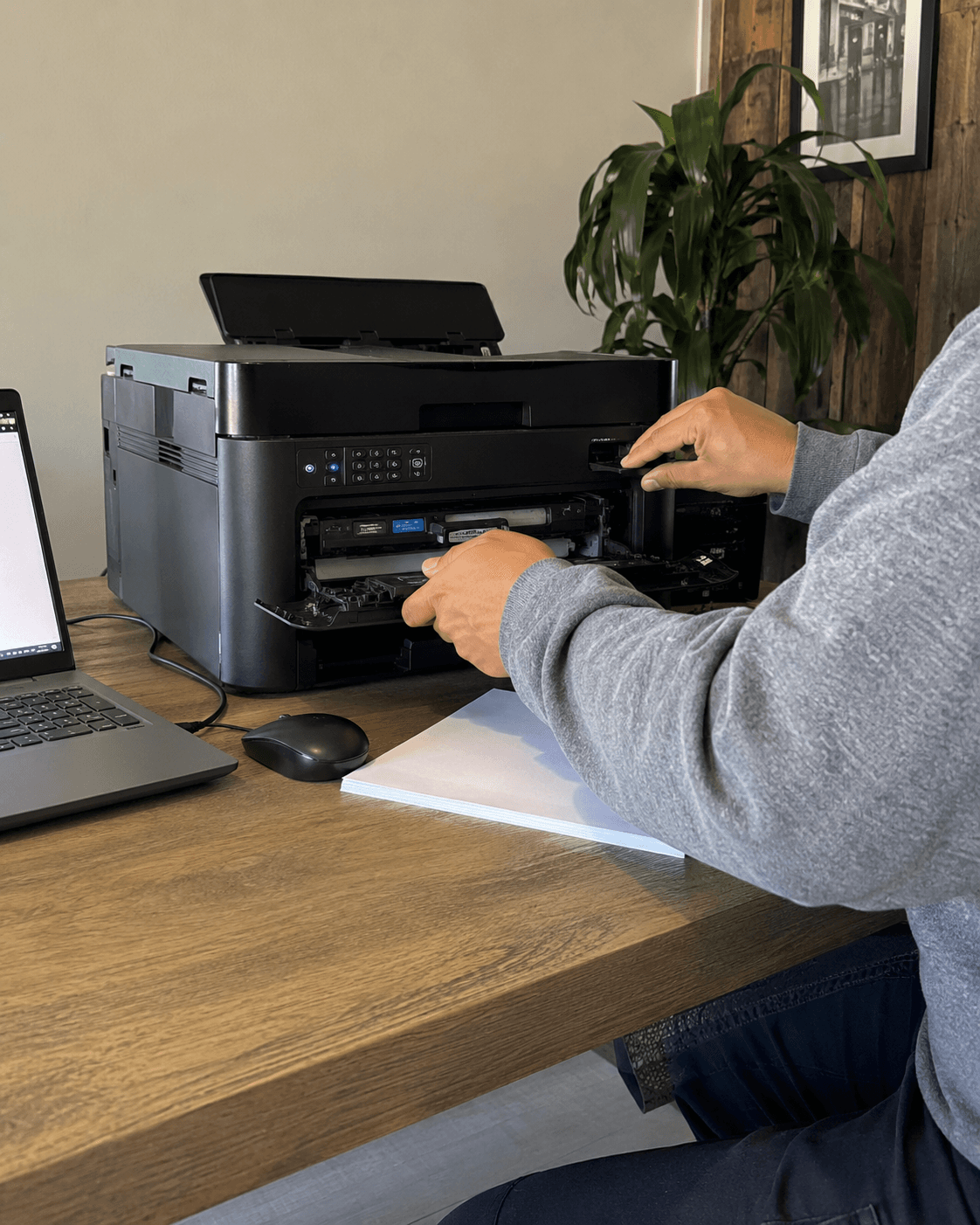
  • At the printer, check power, paper, doors, ink or toner warnings, and the exact error code. Stop for smoke, sparks, unusual heat, liquid, a damaged power cord, or a mechanism that would need to be forced or opened.
  • If the model’s official manual provides a local copy or built-in test-page procedure, use a blank or non-private test with the owner’s approval. A local failure points toward printer, consumable, or hardware trouble before the computer or network.
  • Compare one known computer with a second trusted device. One-device failure suggests that device’s queue, driver, app, or permissions; every-device failure suggests the printer, shared connection, or network path.
  • Trace the connection that is actually in use. For USB, inspect the ordinary cable and approved port without adding unknown adapters. For Ethernet or Wi‑Fi, confirm the intended local network rather than guest Wi‑Fi, an old router name, or a neighboring network.
  • Open the affected operating system’s printer queue and record whether it is paused, set offline, pointing at a duplicate printer, or blocked by a specific job. Cancel only owner-approved disposable jobs; do not delete another user’s work or clear every shared queue blindly.
  • Check whether the saved printer address or port still matches the printer after a router change. Treat local IP addresses, MAC addresses, SSIDs, and configuration pages as private support details, not information to paste into public forms or AI chats.
  • Use current Microsoft, Apple, and manufacturer instructions for the exact operating system and model before changing a driver or firmware. Download only from an official source, and do not factory-reset, update firmware, or remove the only working queue without approval and a recovery path.
  • Test scanning as a separate path after printing is understood. Compare the approved manufacturer app with the operating system’s scan tool, but do not configure scan-to-email, cloud folders, address books, or saved credentials without the owner present.

When to call

  • The printer is shared by several people, mixes Windows and Mac devices, or supports a home-office workflow that should not be disrupted by trial-and-error resets.
  • An ISP gateway, router, mesh, or network-name change left the printer, scanner, cameras, or other devices on different networks.
  • The printer can make a local test but the USB, Ethernet, Wi‑Fi, address, queue, driver, or scan layer remains unclear after the safe checks.
  • The device reports repeated jams, printhead or service errors, leaking ink or toner, damaged power, smoke, sparks, unusual heat, or internal hardware trouble; stop using it and follow the manufacturer or qualified repair path.
  • You need an approved scan-to-folder, scan-to-email, shared-printer, or replacement plan with account ownership and privacy requirements documented first.

How Tech Genie helps

Solve the problem and make it easier next time.

Tech Genie identifies the cause, handles the agreed work, and explains what changed and what to do next.

Scope whether the symptom belongs to the printer, one device, every device, a USB or network path, a queue, a driver, or scanning before changing the setup.
Run owner-approved, non-private tests and review ordinary cables, the intended local network, printer address or port, queues, official software, and scan apps without collecting passwords or document contents.
Make only approved, reversible configuration changes; route proprietary firmware, warranty, internal hardware, ISP, or account work to the responsible vendor when that is the correct owner.
Provide a service summary with the connection method, test results, approved changes, remaining exceptions, and a repair-or-replace recommendation.

FAQ

Quick answers before booking.

Should I delete and reinstall the printer?

Not first. Record the current printer, port or address, driver, and any device that still works. If the queue is paused, the printer moved to a different network address, or only one computer fails, deleting it can erase useful evidence without fixing the failed layer.

Why does the printer say offline when it is connected to Wi‑Fi?

The printer may be on a guest or old network, the computer may have a stale address or duplicate queue, or the printer may be reachable from only part of the network. Confirm the intended network and compare a second trusted device before changing router or printer settings.

Why can I print but not scan?

Printing and scanning can use different apps, services, permissions, and destination accounts. Prove printing first, then test the approved manufacturer app and operating-system scan tool separately. Do not add email, cloud, or folder credentials just to make a test pass.

Is it safe to clear the print queue?

Review it first. Cancel only jobs the owner confirms are disposable, especially on a shared printer. A queue may contain another person’s work or a private document name, and clearing everything can remove evidence of the one job or format causing the failure.

Can Tech Genie repair every printer hardware problem?

No. Tech Genie can isolate the problem, restore supported connection and workflow issues, and explain the recommended next step. Proprietary hardware, printhead, warranty, parts, electrical, and internal mechanical repairs may belong with the manufacturer, a repair depot, or replacement.

Keep troubleshooting

Tech Genie is not a licensed contractor. Construction-related work is limited to casual, minor, or inconsequential projects totaling less than $1,000 for labor, materials, and all other items, requiring no building permit, and performed without employees or paid helpers.